Incident Intelligence — Now in Early Access

Stop Solving the Same Incident Twice

Sentinel turns incident response into structured, repeatable workflows.

Try Interactive Demo
Trusted by on-call teams at engineering-first companies
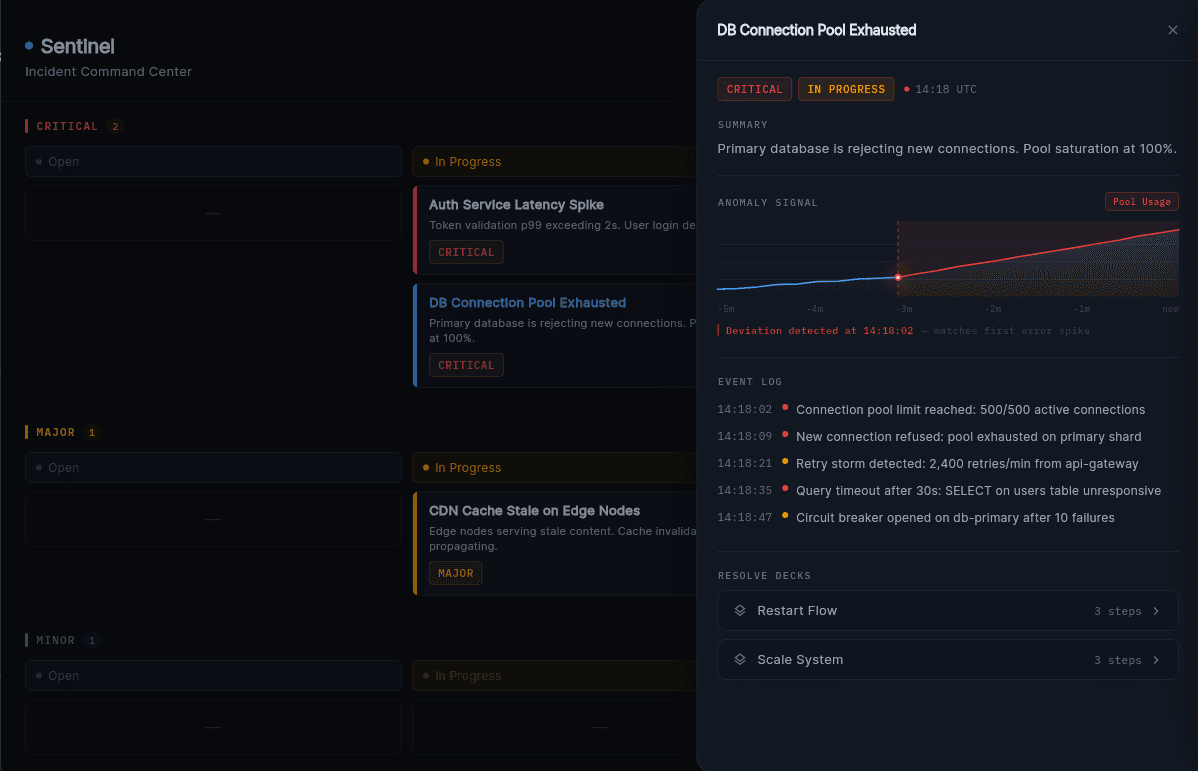
sentinel.app / incidents
sentinel_incident mockup

The Problem

You're not solving incidents. You're repeating them.

Signal Overload

Same alerts, different days

Your monitors fire the same alert every week. Your team investigates from scratch — every time. There's no memory between incidents.

Payment P99 > 2000msMon 09:42
Payment P99 > 2000msWed 14:12
Payment P99 > 2000msFri 22:07
Knowledge Loss

Knowledge lost in Slack

The fix lives in a thread from 6 weeks ago. Nobody knows who found it. By the time you search, you've already lost 40 minutes.

A
alex6w ago

I think it was the connection pool again

S
sam6w ago

found it — scale replicas first then check redis

J
jordannow

anyone remember how we fixed this last time?

Process Failure

Runbooks that nobody follows

Your wiki has 47 runbooks. In an incident, nobody reads them. They're stale, unstructured, and disconnected from the actual alert.

payment-runbook-v3.md
Updated 8 months ago
2 read
db-incident-guide.md
Updated 14 months ago
0 reads
sre-playbook-2022.md
Updated 2 years ago
1 read

Reframe

The problem isn't incidents.
It's the lack of structure.

Incidents will always happen. The question is whether your team responds with clarity — or improvises under pressure, every time.

Without Structure
  • React from memory
  • Improvise each step
  • Knowledge evaporates
  • Next incident, start over
With Sentinel
  • Structured response, always
  • Steps matched to incident
  • Knowledge captured inline
  • Next incident, reuse it

The Solution

Structured Incident
Intelligence

Capture context. Suggest actions.
Execute with clarity.

Capture Context

Every step, decision, and fix is captured. Not in Slack. In the workflow, where it belongs.

Suggest Actions

Sentinel matches your incident to known patterns and surfaces the right steps — before you have to think of them.

Execute with Clarity

A live, structured checklist replaces tribal knowledge. Everyone knows what's done, what's next, and who owns it.

Incident WorkflowLIVE
Capture
Incident detected — Payment P99 spike
Matched to runbook: Payment Service Degradation
Suggest
Suggested actions loaded
7 steps. Priority ordered. Context attached.
Execute
Step 4: Scale payment replicas
Assignee: @alex — in progress
Reuse
Workflow saved for next time
Will auto-suggest on similar incidents

How It Works

Three steps to
structured response

01

Select the Incident

When an alert fires, Sentinel surfaces the incident automatically. No manual triage. No digging through dashboards. The context is already there.

  • Alert ingestion from PagerDuty, Grafana, DataDog
  • Auto-classification by severity and service
  • Historical context from similar incidents
Active Incidents
INC-041critical
Payment latency spike
High match
INC-040high
Auth token cascade
Exact match
02

Understand the Context

Sentinel surfaces what matters — past resolutions, affected services, ownership, metrics. You don't search. You respond.

  • Linked past incidents and their resolutions
  • Service ownership and escalation paths
  • Real-time metrics embedded in context
Incident Context
Similar toINC-039 (resolved)
OwnerPlatform team
Root cause (last)DB pool exhausted
Resolution time (avg)22 min
03

Execute Once, Reuse Forever

Run through the workflow. Every decision is saved. Next time a similar incident fires, Sentinel already knows what to do.

  • Live checklist updated by any team member
  • Decisions and notes captured inline
  • Workflow promoted to template automatically
Saved as Template
REUSABLE
Confirm scope & affected services
Scale replicas (payment-svc)
Check Redis queue depth
Run query analysisREUSED
↻ Used 3 times · Saved 68 min total

Value

What Sentinel gives your team

Never repeat the same incident response

Every resolved incident is a step toward a smarter system. Sentinel captures what worked, making each response faster than the last.

68%reduction in repeat incident time

Turn incidents into reusable knowledge

Stop losing context to Slack threads and stale wikis. Every workflow becomes a living asset your team can build on.

100%of resolutions captured automatically

Align your team under pressure

A live, shared workflow means no more parallel threads, no more 'what's the status?', no more dropped balls during an incident.

faster mean time to resolution

Product

From chaos to execution —
in one interface

Sentinel sits between your alert system and your team. It transforms raw signals into structured, executable workflows.

Chaos
Alert fires. Slack explodes. Team improvises.
PagerDuty alert
Grafana spike
Customer report
SENTINEL
Structure
Context captured. Workflow matched. Team aligned.
Incident classified
Runbook matched
Steps prioritized
EXECUTE
Execution
Resolved fast. Knowledge saved. Reused forever.
Incident resolved
Postmortem generated
Template saved

“Sentinel doesn't replace your team's judgment. It gives your team a structure to execute that judgment — consistently, every time.”


Get Started

Stop solving the same incident twice.

Choose how you want to experience Sentinel — explore the demo, talk to the team, or get early access.

Try Interactive Demo

Explore how Sentinel structures incident resolution — step by step. No signup required.

Launch Demo
5 min guided walkthrough · No account needed

Get Early Access

Be the first to stop repeating incidents. Join the waitlist — no commitment required.

No spam. Unsubscribe anytime.

Contact

Let's talk about
your incidents

Whether you want a demo, have questions about how Sentinel fits your stack, or just want to see it in action — we're here.

Email
team@sentinel.app
Response time
Usually within 24 hours
For demos
We tailor it to your stack

No spam. We'll only reach out about Sentinel.